Private contracts
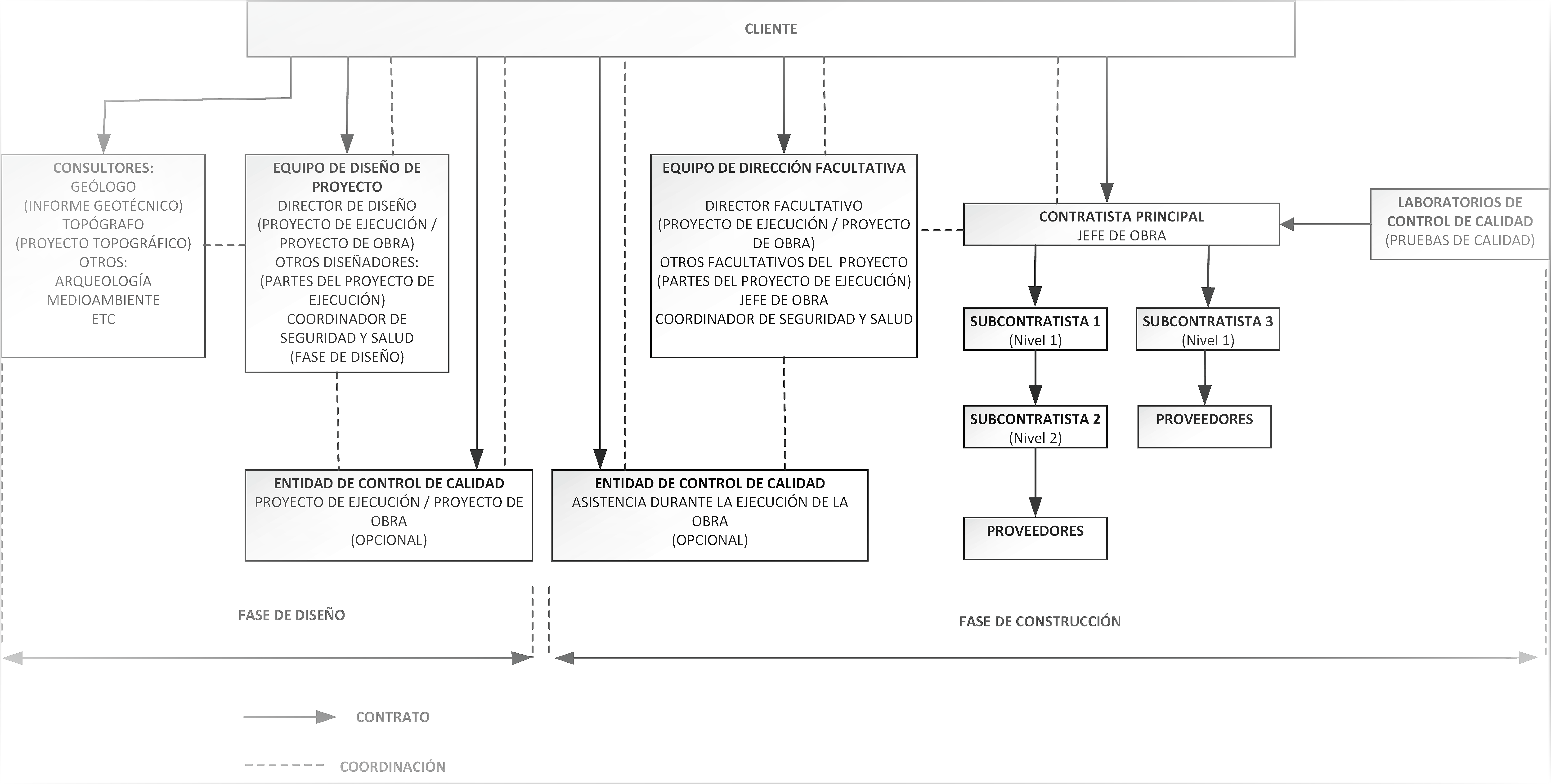
The traditional method of contracting works in Spain follows the Design - Award - Construction process, known in English as Design - Bid - Build (DBB). Spanish laws and regulations were developed with this method as reference, this is the reason why it is privileged over other methods that have been developed. The emergence of a new discipline called Project Management and Direction in the Anglo-Saxon world, backed by universally recognized policies and standards, has introduced new responsibilities, methods and terminology that is applied in large international projects and that is also spreading throughout the world of construction in Spain.
a. Traditional method in Spain
It is the one show none the figure:
 b. Design – Bid – Build (DBB)
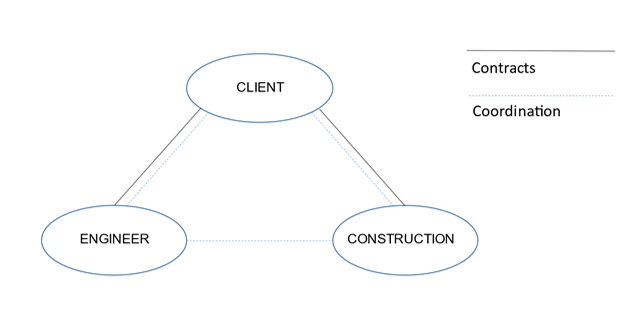
In this method the client hires an engineer or architect to provide complete design services. The client then announces and awards a separate construction contract based on the architect's documents. The client is therefore responsible for the design details and accountable to the contractor for the quality of the construction contract documents. DBB projects can also be awarded to the lowest bidder (lump sum) or negotiated to reduce the likelihood of the project being be awarded to a contractor who has submitted a too low or even a reckless bid. In the DBB method the contractor is not involved in the design phase. The client can entrust the control of the work to the same architect who made the design or to a different one. The client hires all the contractors involved in the work and pays for each contractor’s certifications once they have been measured and approved by the architect. It is summarized in the following figure below:
The traditional method can be simplified by reducing the number of customer partners, using one of the following methods:
i. Construction Management (CM).
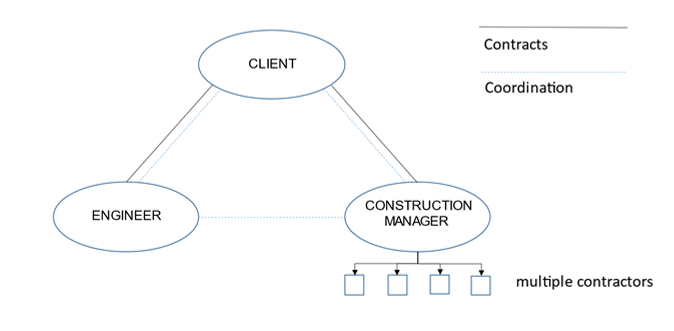
CM deals exclusively with construction-related activities. He or she is an expert in all the trades involved in a construction site, manages the day-to-day operations, and ensures that materials are delivered on time, that the necessary machinery and tools arrive on time, and that the necessary human and material resources are available for each job. This system has two variants:
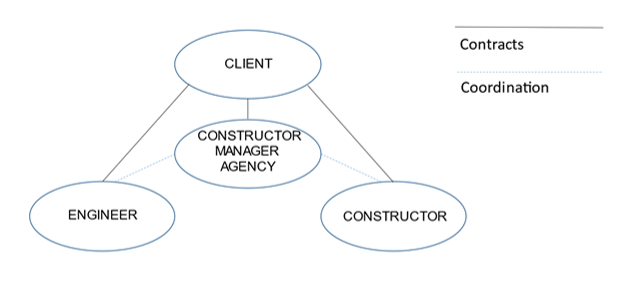
ii. Construction Manager Agency (CMA).
The client selects the main contractor and receives technical advice and ongoing service throughout the project. The CMA can act legally on behalf of the client to sign documents and make project-specific decisions. A CMA agreement can be structured to cover the entire project, from design to delivery, or for a specific segment of the design or construction process. It is summarised in the figure below:
iii. Construction Manager at Risk (CMR).
Method involving the CM's commitment to adhere to a Guaranteed Maximum Price (GMP). The CM acts as the client's consultant in the project drafting phase and as the main constructor in the execution phase. Since it must comply with the GMP, the nature of its relationship with the developer is substantially modified, since in addition to acting in defence of the latter's interests, it must also defend its own interests. Most of the time the client has a separate design contract and provides the construction manager with a complete set of plans and specifications. It is summarised in the figure below:
iv. Project Manager (PM).
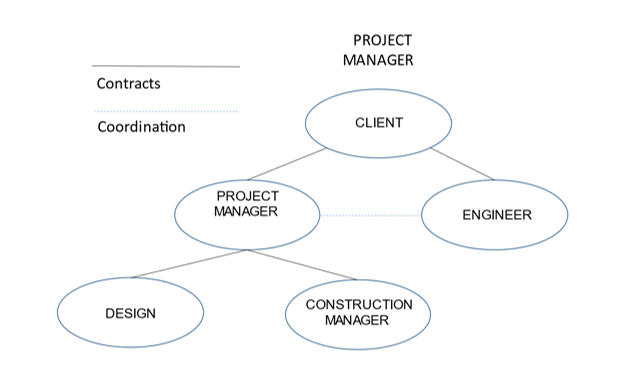
He PM is involved in all aspects of the construction project. This includes initial planning, site selection and analysis, design, procurement, construction and resource mobilisation. The PM is responsible for the budget and the schedule or progress curve of the project and must monitor any deviations that increase the duration or cost of the project and propose corrective measures to mitigate those risks. This system is typical of complex projects and usually the PM oversees the CM.
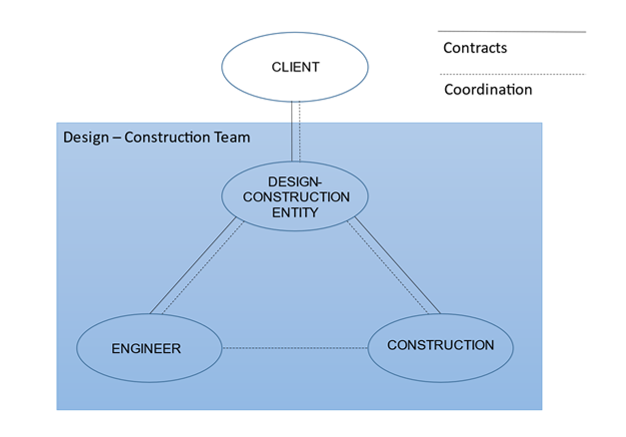
c. Design – Build (DB).
DB is often used for smaller projects due to its greater simplicity. The client hires a single designer/builder to provide architectural and engineering services and construction. The DB entity is responsible for all design and construction costs and in most cases provides a fixed price and delivery schedule. It is summarised in the figure below: